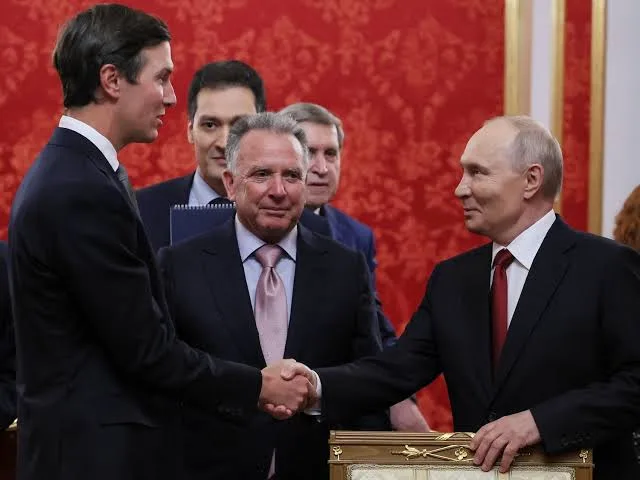

US President Donald Trump’s envoys, Steve Witkoff and Jared Kushner, arrived at the Kremlin on Thursday for talks with Russian President Vladimir Putin as Washington renewed efforts to secure a peace agreement to end the war in Ukraine.
The November 12 meeting followed two days of US-led trilateral negotiations involving Russia and Ukraine in Abu Dhabi, where the parties reported some progress but failed to announce a breakthrough on major issues.
Also read: Zedvance launches ExtraCash Credit Solution for Nigerians
The talks in the United Arab Emirates were the first direct US-mediated negotiations between Moscow and Kyiv in nine months.
However, the sides said they had agreed on a major prisoner-of-war exchange expected to take place in the coming weeks.
Speaking to reporters before the Kremlin meeting, Witkoff expressed cautious optimism when asked whether progress in the negotiations meant peace was closer.
“I hope so,” he replied.

The US delegation was expected to travel to Dublin later on Thursday for discussions with Ukrainian President Volodymyr Zelensky, who said on Wednesday that he hoped an agreement could be reached before the end of 2026.
Zelensky, however, said the outcome would depend significantly on Washington’s approach to Moscow.
Trump has instructed Witkoff and his son-in-law, Kushner, to intensify efforts to end the conflict, which began with Russia’s full-scale invasion of Ukraine in February 2022.
The US president, who previously claimed he could end the war within 24 hours, said last week that the conflict was close to being resolved through what he described as a “big beautiful agreement”.
However, several of his earlier predictions of a breakthrough have not materialised.
The most difficult issue in the negotiations remains control of territory, particularly in eastern Ukraine.
Moscow has demanded that Kyiv surrender the entire Donbas region as part of a peace settlement.
Ukraine has rejected the demand, while Russian forces continue military operations to capture territory in the region.
Russia has made no major territorial gains this year, according to the report, but has continued attacks on Ukrainian infrastructure. Ukraine, meanwhile, has frequently targeted Russian oil refineries with drones, contributing to fuel shortages reported in some Russian regions.
Putin has given no indication that he is prepared to soften his territorial demands. These also include establishing a buffer zone in parts of Ukraine that Russia has not formally claimed as its own.
Vladimir Medinsky, Putin’s lead negotiator at the Abu Dhabi talks, reinforced Moscow’s position in comments to Russian state television on Wednesday.
“Wherever the foot of our Russian soldier has stepped, that is ours,” he said.

The TASS state news agency also quoted Medinsky as saying that “every inch” of territory Moscow considers Russian would be returned.
The negotiations have also exposed differences over whether the European Union should have a direct role in the peace process.
Ukraine and several European countries, backed by the United States, want the EU included in the discussions.
The bloc’s major member states have been among Kyiv’s strongest supporters since the invasion.
The Kremlin has said the EU could be included at some stage but has questioned the bloc’s readiness to participate.
Moscow has cited what it describes as a lack of constructive proposals from Brussels and the absence of an agreed representative for any future negotiations.
EU foreign policy chief Kaja Kallas accused Russia on Monday of pretending to negotiate while continuing attacks on Ukraine. She said Moscow had shown no goodwill towards reaching peace.
With discussions over territory still deadlocked, US mediators have sought to shift attention towards post-war security guarantees and reconstruction.
Russia has also called for a broader security framework for Europe after the conflict.
On Wednesday, a senior Russian diplomat said Moscow could enter into non-aggression agreements with NATO member states.
The proposal has raised concerns in Kyiv and among its allies about the wider implications of any post-war security arrangement.
European Commission President Ursula von der Leyen said on Monday that broader European security discussions should take place only after a ceasefire in Ukraine.
Moscow has rejected the idea of a temporary ceasefire, arguing that it wants a comprehensive agreement to end the war rather than a pause that could allow Ukraine to rearm.
The latest diplomatic engagements therefore leave several major questions unresolved, particularly over territory, security guarantees and the role of European countries.
Also read: Zedvance launches ExtraCash Credit Solution for Nigerians
The proposed prisoner exchange represents a limited area of progress, but the wider negotiations remain without a confirmed peace agreement.

Mariam Balogun is a contributor to Freelanews.com, covering news, business, and public affairs.