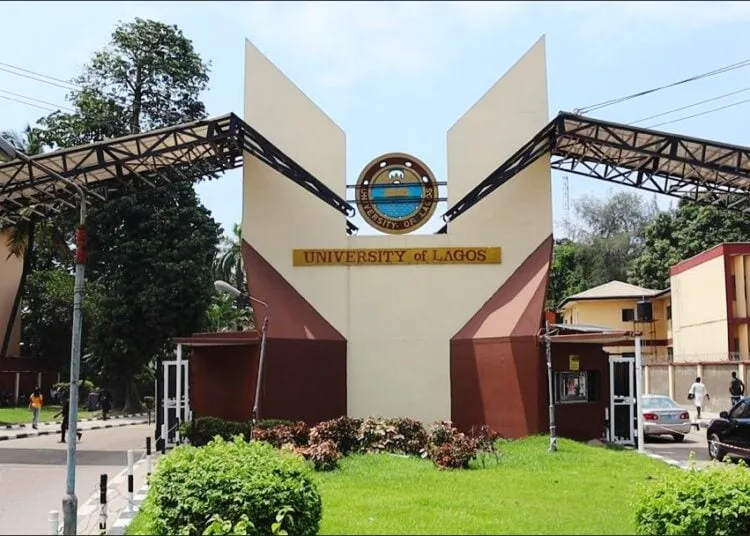

The University of Lagos (UNILAG) has emerged as Nigeria’s leading institution in the 2027 QS World University Rankings: Sustainability, after rising more than 700 places to secure joint 697th position globally.
The university moved from the 1,401–1,500 bracket in the 2026 edition to the global top 700 in the latest rankings released on Tuesday, November 17, 2026.
Also read: Jimmy Odukoya rejects removal as church pastor
Chairman of the Nigerian Tertiary Education Ranking Advisory Committee, Prof. Peter Okebukola, announced the development while presenting the committee’s report to the Minister of Education, Dr Tunji Alausa, in Abuja.
According to Okebukola, UNILAG recorded the largest improvement by an African university and one of the three biggest advances globally among the 1,819 institutions assessed in both editions.
He described the performance as evidence that Nigerian universities could make significant progress in international rankings despite operating under challenging conditions.
“A Nigerian public university, working under the same conditions as its peers, has shown in 12 months that rapid progress is possible,” he said.

The committee disclosed that UNILAG improved its performance across all 11 indicators used by QS, with its strongest gains recorded in Environmental Education, Governance and Equality.
The institution also ranked 14th among 82 African universities included in the assessment, placing ahead of the University of Ghana, Makerere University, Addis Ababa University and the University of Nairobi.
The University of Ibadan also recorded an improvement, moving from the 1,301–1,400 category to the 1,201–1,250 bracket.
It achieved the best position among Nigerian universities in the Employability and Opportunities category, securing joint 495th place globally.
Other Nigerian institutions featured in the ranking were Ahmadu Bello University, Zaria; the University of Nigeria, Nsukka; and Obafemi Awolowo University, Ile-Ife.
Although they remained in the 1,501-plus category, their scores improved in several assessment areas.
NiTERAC said the average scores of the six Nigerian universities included in the ranking increased across all performance indicators.
It added that Nigeria now performs above the global median in Knowledge Exchange and Employability and Opportunities, while matching the global median in Environmental Education.
The country’s position among African nations also improved, moving from sixth to fourth based on the highest-ranked university in each country.
According to the committee, Nigeria now has the highest-ranked institution in Sub-Saharan Africa outside South Africa.
Explaining the factors behind the progress, Okebukola highlighted the role of a stable academic calendar, improved salaries for university staff and increased investment in teaching and research facilities, particularly through the Tertiary Education Trust Fund.
He said the gains reflected cooperation between government and university authorities, urging both sides to maintain the conditions that supported the improvement.
However, the committee raised concerns about Nigeria’s limited representation in the ranking, noting that only six universities featured out of more than 300 institutions in the country’s tertiary education system.
It also observed that Covenant University, which led Nigerian institutions in the 2026 edition, dropped to the 1,151–1,200 category in the latest assessment.
NiTERAC identified Governance, Environmental Research, Equality, Environmental Sustainability, and Health and Wellbeing as areas requiring further attention.
The committee said some of the weaknesses were linked more to institutional policies, documentation and public disclosure than to funding, suggesting that universities could address them within one or two ranking cycles.
It recommended that universities publish sustainability policies approved by their governing councils, provide online access to audited financial statements and governance documents, and introduce policies covering equality, inclusion, health and wellbeing.
It also called for the establishment of research clusters focusing on climate change, energy, water and food security, as well as the appointment of sustainability officers to coordinate submissions to international ranking bodies.
For the Federal Government, the committee proposed a national sustainability policy framework for tertiary institutions and a dedicated TETFund intervention for green campus infrastructure and sustainability research.
It further recommended that the National Universities Commission include sustainability and transparency indicators in its accreditation process.
To encourage wider improvements, NiTERAC plans to organise a peer-learning forum where UNILAG will share its experience with other universities.
It also proposed annual training programmes for directors of academic planning and ranking officers through the Virtual Institute for Capacity Building in Higher Education.
The committee set a target of having at least 10 Nigerian universities featured in the 2028 sustainability ranking, with three among the world’s top 1,000 institutions.

For the 2030 and 2031 editions, it proposed increasing the number to at least 20 Nigerian universities, with eight ranked among the top 1,000 and the country’s leading institution reaching the global top 400.
Congratulating UNILAG, the University of Ibadan and Covenant University, Okebukola stressed that improved international rankings must be matched by better educational standards.
The QS World University Rankings: Sustainability assesses universities based on their environmental and social impact, as well as governance.
Also read: Jimmy Odukoya rejects removal as church pastor
It examines their contributions to sustainability through research, teaching, campus operations and engagement with society.

Peculiar Adirika is a journalist and contributor to Freelanews.com, covering news, business, and public affairs.