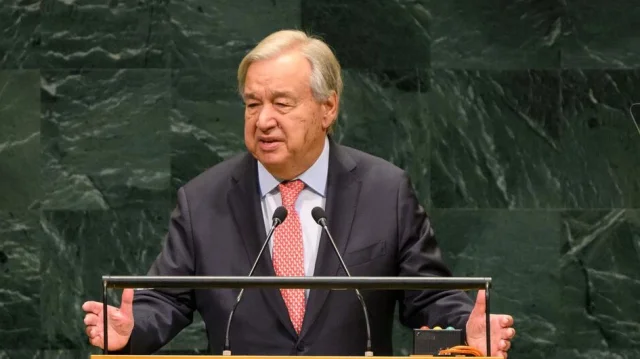

United Nations Secretary-General António Guterres has urged countries to establish legally binding rules governing the use of lethal autonomous weapons systems, warning against the growing threat posed by artificial intelligence-powered weapons on battlefields.
Guterres made the appeal on Monday in a video message to representatives attending a United Nations conference in Geneva, where 128 countries are considering whether to begin negotiations on international regulations for autonomous weapons.
Also read: UK expands paid jobs scheme for 90,000 young people
He called for an agreement that would clearly prohibit certain weapons and restrict others, stressing the need to prevent the development and spread of machines capable of making life-and-death decisions without human intervention.
“I call on you to move towards negotiating a legally binding instrument to regulate autonomous weapon systems — including clear prohibitions and restrictions,” he said.
“Seize this moment,” Guterres added, urging governments to take action against what he described as “merciless weapons”.
He warned that protecting civilians from the devastation of armed conflict and preventing unnecessary suffering must remain a global priority.

The discussions come amid rapid advances in military artificial intelligence, with armed forces increasingly exploring technologies that can identify and strike targets with greater speed and precision.
Human Rights Watch has also warned that failure to establish meaningful restrictions could leave civilians dangerously exposed to the risks associated with autonomous weapons.
The International Committee of the Red Cross said the urgency of regulating the technology had increased significantly because of recent developments in artificial intelligence.
Laurent Gisel, head of the ICRC’s Weapons and Conduct of Hostilities Unit, said the international community needed to respond to the growing capabilities of autonomous military systems.
However, disagreements among major military powers continue to complicate efforts to reach an agreement.
Russia’s representative attempted on Monday to prevent observer states and civil society organisations from accessing the discussions, a move criticised by campaigners who said it could shield Moscow from scrutiny over its alleged use of autonomous weapons.
Russia has reportedly deployed fully autonomous drones in Ukraine, while Ukraine’s defence industry is working towards developing autonomous drone swarms.

At the United Nations General Assembly last month, 163 countries adopted a resolution calling for negotiations on rules governing autonomous weapons.
The United States, Russia, Belarus, Israel and North Korea voted against the resolution, while nine countries, including Iran, Saudi Arabia and China, abstained.
Laure de Roucy-Rochegonde of the French Institute of International Relations described China’s position as one of “carefully cultivated ambiguity”.
Washington has proposed a five-year process to develop a non-binding agreement, while non-governmental organisations and the ICRC are pushing for negotiations to be completed within one year.
In 2023, Guterres and then-ICRC President Mirjana Egger called on governments to prohibit autonomous weapons before 2026.
The ICRC is advocating a ban on two categories of weapons: unpredictable autonomous systems and those designed or used to directly target human beings.
Also read: UK expands paid jobs scheme for 90,000 young people
Despite growing international support for tighter controls, observers say opposition from influential military powers could prevent countries from agreeing to begin negotiations on legally binding restrictions during the Geneva meeting.

Peculiar Adirika is a journalist and contributor to Freelanews.com, covering news, business, and public affairs.