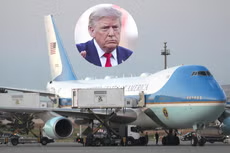

US President Donald Trump, US intelligence and Secret Service officials carried out an extraordinary security operation in Ankara, Turkey, on July 8, 2026, secretly moving Trump from the presidential aircraft to a smaller military jet after intelligence indicated a possible Iranian threat against his flight.
The details of the Trump secret flight emerged this week through reporting by The Washington Post, The Wall Street Journal and other major outlets, revealing that an airport catering truck was used to move Trump away from the aircraft that journalists and some White House officials believed he was travelling on.
Also read: Celta Vigo stadium hit by fungus scare before opener
The operation unfolded after Trump’s attendance at the NATO summit in Ankara.
According to the reporting, Trump publicly boarded the older Boeing 747 used as Air Force One, allowing television cameras to capture his departure.
He then secretly left the aircraft from the opposite side and was transferred using an airport catering vehicle to a smaller US military C-32A aircraft.
The deception was designed to conceal Trump’s actual location.

Journalists travelling with the presidential delegation and some White House staff members reportedly believed Trump remained aboard the 747.
The aircraft consequently operated as a decoy while Trump travelled separately.
The Wall Street Journal reported that Israeli intelligence had alerted US officials to a potential Iranian threat involving shoulder-fired missiles aimed at Air Force One.
The report said the warning contributed to the decision to move Trump to another aircraft.
The precise nature and credibility of the intelligence remain matters of national security, and officials have not publicly disclosed all the underlying information.
The security concern was not entirely unexpected. Trump has faced repeated threats from Iran amid the sharp deterioration in relations between Washington and Tehran.
Trump himself acknowledged the broader danger when questioned by reporters after the flight.
“I have a threat all the time. I’m number one on their list, before you,” Trump said, adding, “But if I go, you go.”
The president’s remarks came after journalists noticed an unusual instruction to keep the windows of the aircraft covered during the flight.
Trump later suggested that the precautions were connected to the threats facing him.
The unusual operation also involved a carefully controlled group of people.
Reporting indicated that several close Trump aides accompanied him during the covert transfer, while senior officials including Secretary of State Marco Rubio remained aboard the decoy aircraft.
The episode has prompted questions about the decision to leave journalists and other personnel aboard an aircraft that was reportedly being used as a decoy.
Some critics have argued that the people aboard the aircraft should have been informed of the potential danger, while supporters of the operation maintain that revealing Trump’s location could have compromised the entire security plan.
Security experts generally recognise the need for presidential protection to involve deception, particularly when intelligence suggests a credible attack.
The difficulty in this case lies in determining how much information can safely be shared with those travelling alongside the president without undermining the operation.
The aircraft issue also has a wider background.
Trump had travelled to Turkey aboard a new Boeing 747-8 donated by Qatar and subsequently modified for presidential use.
The aircraft has attracted scrutiny over whether it possesses all the sophisticated defensive and communications capabilities of the established Air Force One fleet.
Rather than using the new aircraft for the return journey from Turkey, Trump publicly said he would travel on the older presidential aircraft while the newer jet travelled ahead to RAF Mildenhall in Britain.
At the time, the White House presented the stop at Mildenhall as an opportunity for US service members to see the new presidential aircraft.
Trump later reunited with the newer aircraft at the British base before continuing his journey to the United States.
Contemporary footage showed him emerging from the older aircraft, helping preserve the appearance that he had travelled on it from Turkey.
The revelation has now transformed what initially appeared to be an unusual aircraft switch into a dramatic example of presidential security deception.
White House Communications Director Steven Cheung defended the extraordinary measures, saying there were “many enemies of America who have their sights on him” and that officials use “every tool at our disposal” to address those threats.

The incident also highlights the difficult balance between presidential security and transparency.
For the Secret Service, concealing the president’s movements can be essential when a threat is considered credible.

For journalists and other officials travelling with a president, however, being deliberately kept unaware of a major security change raises legitimate questions about risk, communication and responsibility.
The operation ultimately succeeded in keeping Trump’s actual aircraft and movements hidden until the journey was over.
Also read: Celta Vigo stadium hit by fungus scare before opener
But its disclosure weeks later has ensured that the secret flight from Turkey is now being examined not only as a remarkable presidential security manoeuvre, but also as a revealing example of the extraordinary measures officials may take when intelligence points towards a potential threat to the US president.

David Okere is a journalist and contributor to Freelanews.com, covering business, governance, public affairs, and human-interest stories with a commitment to accuracy, balance, and public interest reporting.