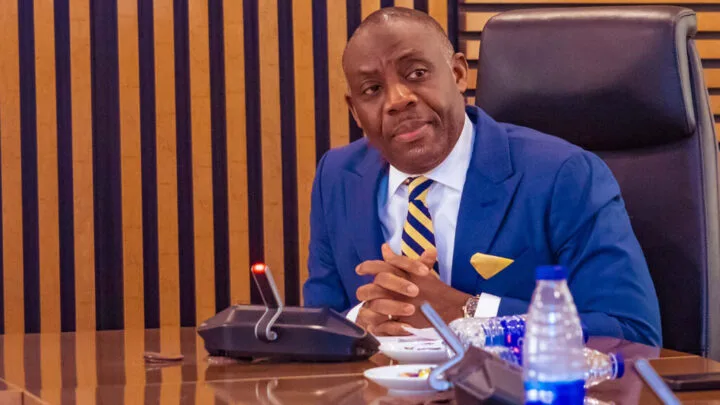

The Minister of Education, Dr Maruf Tunji Alausa, has criticised former Vice-President Atiku Abubakar and former Anambra State Governor Peter Obi over their positions on the Nigerian Education Loan Fund (NELFUND), insisting that the programme is beneficial to Nigerian students and backed by a sustainable funding arrangement.
Alausa made the remarks on Monday, November 16, 2026, during the unveiling of the Renewed Hope Education A-Z scorecard at the All Progressives Congress Presidential Campaign Council headquarters in Abuja.
Responding to criticisms of the student loan scheme, the minister described the positions of the two opposition figures as incorrect and challenged them to examine the legal provisions governing its funding.
“Nigerians, what the candidates, Peter Obi and Atiku Abubakar, are saying are incorrect,” he said.
He added, “Nigerians should stop encouraging irresponsible and nonsensical behaviour. If anybody says NELFUND is not beneficial to Nigerian students, that person needs to have his head checked.”

Explaining the funding structure, Alausa said the Nigeria Tax Act provided for 15 per cent of the proceeds from the four per cent development levy to be allocated to NELFUND.
He described the allocation as a statutory provision designed to provide a steady source of funding for the student loan programme.
The minister also disclosed that the fund had received more than ₦130bn from tax collections, although the full implementation of the 15 per cent allocation was yet to take effect.
Alausa urged opposition politicians to present alternative policies rather than dismiss government programmes, arguing that NELFUND was introduced to help students access tertiary education despite financial difficulties.
“Do not simply attempt to discredit one of the best and most innovative programmes Nigeria has introduced to support students,” he said.
Also speaking at the event, former Edo State Governor and Senator representing Edo North, Adams Oshiomhole, criticised Atiku’s position on tertiary education financing.
Oshiomhole argued that NELFUND challenged what he described as Atiku’s preference for privatising tertiary education, questioning the suitability of such an approach in a country where millions of children still lack access to basic education.

He challenged opposition politicians to explain whether they intended to retain or discontinue existing government education policies if elected in 2027.
Obi had previously described NELFUND as a “wasteful venture”, arguing that the government should prioritise direct investment in education and improve funding across the sector rather than rely on student loans.
The former Anambra governor’s criticism centred on the government’s education spending priorities and the need to strengthen public education.
Atiku, on his part, has questioned the idea of using loans to finance students’ education, arguing that graduates should not begin their working lives burdened by debt.
In September 2026, the former vice-president, through his Senior Special Assistant on Public Communication, Phrank Shaibu, announced that he would review the existing NELFUND arrangement and introduce debt forgiveness for qualifying students if elected president in 2027.
Atiku’s position is that government should reduce the underlying cost of education, while eligible students who have already benefited from loans should be considered for debt relief under his proposed policy.

AbdulBasit Saba is a journalist and contributor to Freelanews.com, covering news, business, and public affairs.