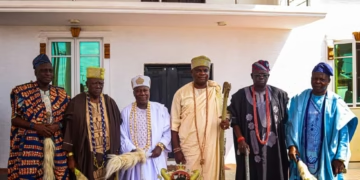
As Lagos prepares for Isese Day on 20 August 2026, the Lagos State Government has launched a public cultural campaign presenting Isese as an enduring part of Yoruba identity, linking communities from Ikeja and Badagry to Ikorodu, Lagos Island and Epe.
The campaign, shared by the Lagos State Government on its official social media channels, seeks to challenge what it describes as misconceptions about the traditional Yoruba festival and encourage residents to engage with their cultural heritage with greater understanding.
Also read: Olowu of Kuta congratulates Adeleke, urges inclusive governance in second term
The government says Isese should not be viewed as outdated or divisive, but as an expression of language, values, festivals and ways of life that remain woven into the cultural history of Lagos.
“Isese is our identity,” the government said in its message, adding that the tradition should be understood through culture rather than assumptions.
The campaign places particular emphasis on Lagos’s five IBILE divisions: Ikeja, Badagry, Ikorodu, Lagos Island and Epe.
The reference reflects the state’s effort to present cultural heritage as something shared across different parts of Lagos rather than confined to a single community.


The approach also gives the celebration a broader human dimension. Rather than presenting Isese solely as an annual event, the government frames it as a living connection between contemporary Lagos and the traditions inherited from earlier generations.
The message comes as Lagos joins other parts of south-west Nigeria in preparing for this year’s Isese observance. The Lagos State Government has previously designated 20 August as a public holiday for the annual celebration.
The government’s campaign is also part of a wider effort to encourage residents to recognise cultural heritage alongside the state’s rapidly changing urban identity.
Lagos is home to a highly diverse population, and official cultural messaging has increasingly sought to balance that diversity with the preservation of indigenous traditions.
For the government, that balance is important. Its message does not describe culture as something preserved only in museums or ceremonial spaces.
Instead, it presents Isese as something that can continue to inform language, community values, festivals and everyday identity.
The appeal to “learn from our culture, not assumptions” is therefore a significant part of the campaign. It suggests that the government wants public discussion of Isese to be based on knowledge and cultural understanding rather than stereotypes.
The campaign also carries a message of pride, encouraging residents to reconnect with Yoruba heritage while recognising Lagos’s distinct history as a cosmopolitan centre.
That message is particularly relevant in a city where rapid development has transformed neighbourhoods and communities across the five divisions.
The government’s cultural framing seeks to ensure that modernisation does not come at the expense of historical memory.

The Lagos State Government has also been pursuing other initiatives centred on community participation and public engagement.
Its Citizens Gate platform, for example, describes the state’s vision as creating a Lagos where people are engaged, fulfilled and able to live in harmony.
The Isese campaign fits naturally within that broader emphasis on participation and shared identity, while giving traditional culture a prominent place in the state’s public conversation.
As 20 August approaches, the central message from the government is clear: the Lagos Isese celebration is being presented not simply as a festival, but as an opportunity to reflect on the traditions, values and history that continue to shape Yoruba life in Lagos.
Also read: Vanguard @ 40: Journalism is madness best unleashed in youth
For residents preparing to mark the occasion, the government’s invitation is equally straightforward: understand the heritage, protect it and celebrate it.

Ibrahim Onipede is a journalist and contributor to Freelanews.com, covering news, public affairs, and human-interest stories.