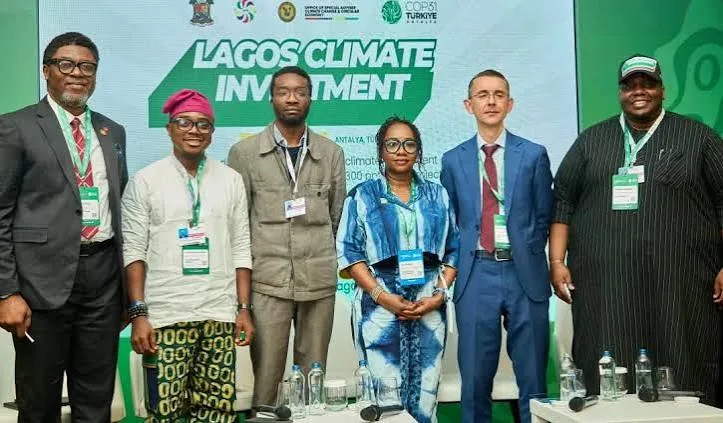

The Lagos State Government, led by Governor Babajide Sanwo-Olu, is seeking international investment and private-sector partnerships to turn its estimated $25bn to $50bn climate investment opportunity into viable projects, following engagements with financial institutions, energy companies and project developers at the 31st United Nations Climate Change Conference (COP31) in Antalya, Türkiye, on November 18, 2026.
The initiative has generated early expressions of interest in healthcare, renewable energy, clean transportation and women’s empowerment, as Lagos seeks to attract capital for more than 300 potential projects identified under its climate investment framework.
Also read:Obasanjo slams Tinubu over subsidy removal plan
The latest developments followed Lagos Climate Investment Day, a special investment engagement organised alongside COP31, where government representatives presented project opportunities to prospective investors and explored financing arrangements with private businesses and financial institutions.
Special Adviser to the Governor on Climate Change and Circular Economy, Titilayo Oshodi, said the discussions had brought together government agencies, private enterprises, young businesses operating in the green economy and financial institutions interested in supporting sustainable development.
She explained that the engagements had moved beyond formal presentations, with investors asking questions, exchanging contacts and exploring possible partnerships with project developers.
“We had a full day of pitches just a few hours ago. The investors that we brought in asked questions, they were exchanging cards. They were having conversations to discover themselves, and they are beginning to look at what is possible going beyond now,” Oshodi said.

The special adviser expressed appreciation to participating financial institutions, particularly Sterling Bank, for engaging with the state and considering ways to support climate-related investments.
She said the government’s priority was to ensure that the financial commitments and discussions generated at international events translated into practical projects, employment opportunities and improvements in residents’ living conditions.
“Let’s carry this momentum. Let’s take it along with us. Let’s turn our pledges into projects. Let’s turn our projects into jobs. Let’s turn our jobs into real impact for Lagos State and, by extension, for Nigeria,” she added.
The investment initiative is built around a pipeline of more than 300 potential projects valued at between $25bn and $50bn, covering clean energy, solar power, transportation, water management, flood resilience, waste management, agriculture and green enterprises.
Oshodi had earlier explained that the figure represented the estimated value of investment opportunities rather than funds already secured, with projects at different stages of preparation and development.
In an interview ahead of COP31, she said the state was working to improve project screening, preparation and financial structuring to make the opportunities more attractive to investors.
Among the private-sector participants, businessman Tonye Cole said the initiative offered an opportunity to connect international capital with sustainable businesses and development projects across Africa.
Cole disclosed that he had worked with his business partner, Funke Shobanjo, to develop a platform designed to connect available global funding with businesses and communities requiring investment.
He said collaboration with the Lagos State Government would help identify viable projects and create opportunities for sustainable financing to reach people and enterprises that needed it most.
“Together, we have developed this platform, and the platform works. What we are now working with Lagos State Government to bring to COP is the opportunity to partner with businesses like ours, with the state government, to develop and work on how sustainable projects and finance can meet the people that need it the most,” Cole said.
Chief Operating Officer of FBNQuest Merchant Bank, Funke Shobanjo, also expressed support for the initiative, saying private investors were prepared to contribute capital through a pan-African sustainable finance platform.
She described the state’s investment ambition as an opportunity to advance climate-related projects while expanding access to financing for businesses and communities.
“Our commitment is in private individuals coming together to provide capital and financing through a pan-African sustainable finance platform,” Shobanjo said.
She also pledged support, alongside her co-founder, for advancing projects within the state’s investment pipeline.
The discussions have also produced potential partnerships in social infrastructure, particularly healthcare and women’s economic empowerment.
A member of the Lagos delegation disclosed that five investors had indicated willingness to partner with projects presented during the engagements.
Among the proposals was support for healthcare insurance initiatives designed to reduce the amount residents pay directly for medical treatment.
Sterling Bank also indicated interest in providing between 50 and 100 tricycles for women’s empowerment programmes, while Worldwide Energy pledged to solarise a primary healthcare centre.
Although the proposed support represents an encouraging development, the individual commitments will still need to progress through implementation arrangements before their full impact can be established.
Climate and carbon asset expert, Dr Adebola Odunsi, said the investment framework could also create opportunities for businesses to collaborate across state boundaries, particularly in waste management and resource recovery.
He explained that materials considered waste in one location could become valuable raw materials for businesses elsewhere, creating opportunities for trade, industrial development and shared environmental benefits.

“The waste that is being generated in one state can become the raw material in another state. So very soon, there are trade opportunities and climate outcome opportunities that we can share, all for the shared climate prosperity of our beautiful country, Nigeria,” Odunsi said.
The Lagos investment drive is part of a broader effort to position the state as a destination for climate finance and sustainable infrastructure development.
Before the Antalya engagements, the government had unveiled its $25bn to $50bn climate investment opportunity during international engagements around the United Nations General Assembly and Climate Week in New York in September 2026.
The framework is anchored in the state’s State-Determined Contributions Framework, which translates climate priorities into investment opportunities across different government ministries and sectors.
The state has also been developing financing mechanisms, including its Climate Finance Preparedness Clinic and Climate Defence and Catalytic Fund, to improve project preparation and address some of the financial risks that discourage private investment.
The Climate Defence and Catalytic Fund is intended to help mobilise capital for climate-resilient and low-carbon infrastructure, although its financial targets should be distinguished from money already committed or disbursed.
Electricity supply remains another major part of the state’s investment agenda.
Lagos State Commissioner for Energy and Mineral Resources, Biodun Ogunleye, said the state required approximately 12,000 megawatts of electricity to meet its estimated demand, making private-sector participation essential to expanding generation and distribution infrastructure.
He maintained that government resources alone could not finance the scale of investment required to address the electricity deficit.
“Our goal as government is to create an enabling environment and not to generate the power ourselves. But reforms alone must not build power plants. Indeed, capital does,” Ogunleye said.
He added that the government was targeting an additional 2,000 megawatts of electricity capacity and had introduced regulatory measures to encourage investment in power generation, distribution and mini-grid development.
The commissioner also urged investors to explore financing opportunities through mechanisms such as the Global Fund for Infrastructure and Investment Finance, particularly those designed to support project preparation and reduce investment risks.
He explained that the government was prepared to provide policy direction, regulatory support and project opportunities, while private investors would contribute capital, technical expertise and asset management.
The state’s electricity investment plans form part of its wider ambition to strengthen energy security, reduce dependence on unreliable power supply and create a more competitive business environment.
Lagos’ participation at COP31 therefore extends beyond presenting environmental commitments to potential international partners.
The government is seeking to demonstrate how climate-related investments can address practical development challenges, including electricity shortages, inadequate healthcare infrastructure, flooding, transportation difficulties and unemployment.
However, the success of the $25bn to $50bn ambition will depend on whether initial expressions of interest translate into formal financing agreements, completed project assessments and actual investment commitments.
For residents and businesses, the most significant measure of progress will be whether these partnerships produce more reliable electricity, improved public services, employment opportunities and infrastructure capable of withstanding climate-related challenges.
Also read:Obasanjo slams Tinubu over subsidy removal plan
The latest engagements have opened discussions with potential investors. The next challenge for the Lagos State Government will be converting those discussions into funded projects with measurable economic and environmental benefits.

Mariam Balogun is a contributor to Freelanews.com, covering news, business, and public affairs.