
Iran has threatened to use all available means to counter a United States naval blockade, describing Washington’s restrictions on its ports and trade routes as an act of military aggression amid the continuing conflict between the two countries.
Iranian Foreign Ministry spokesman Esmaeil Baghaei issued the warning on Monday, saying Tehran would not accept the blockade and was entitled to defend itself under international law.
Also read: Belgium braces for major flight disruptions as strike looms
“We will certainly not tolerate these actions and will use all available means to counter US aggression,” Baghaei said during a news briefing.
He argued that the restrictions imposed by Washington went beyond ordinary economic sanctions and amounted to military action against Iran.
“Under these circumstances, Iran is entitled, pursuant to Article 51 of the UN Charter, to use any means at its disposal to defend itself,” he said.
The blockade was first imposed on April 13 during the nine-month conflict involving the United States, Israel and Iran. Washington lifted it in June after reaching a draft understanding with Tehran, but reinstated the restrictions on July 14 after the agreement collapsed.

The war began on February 28, when the United States and Israel launched air strikes that killed Iran’s Supreme Leader, Ali Khamenei, and other senior officials.
The conflict subsequently spread across the region as Iran launched missile and drone attacks, while armed groups backed by Tehran in Lebanon, Yemen and Iraq also became involved.
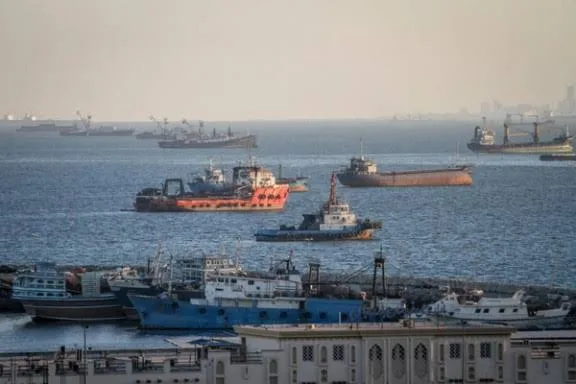
The Strait of Hormuz has emerged as a major flashpoint in the conflict because of its importance to global oil and natural gas shipments. Iran has continued efforts to restrict access to the strategic waterway, prompting Washington to impose restrictions on Iranian ports in an attempt to force Tehran to end its actions there.
The United States has also announced additional economic sanctions and established a task force aimed at disrupting land routes into Iran.
Iranian forces have made several announcements in recent weeks about ships catching fire while attempting to use routes Tehran considers prohibited.
The blockade has also sharply affected Iran’s oil trade. Visible exports of Iranian crude have fallen to near zero in recent months, according to the report.
TankerTrackers.com said last week that a tanker was loading Iranian crude in the Gulf through a ship-to-ship transfer. The vessel could become the first to successfully export the country’s crude since Washington reinstated the blockade in July.
However, Baghaei dismissed reports about Iranian ships loading oil as speculation.

Al Jazeera correspondent Resul Serdar Atas, reporting from Tehran, said the restrictions were putting significant pressure on Iran’s economy because of the country’s dependence on southern ports and the Strait of Hormuz for international trade.
He reported that more than 80 per cent of Iran’s imports and exports passed through the waterway or the country’s southern ports.
According to Atas, Iranian officials and the public were increasingly discussing ways to end the blockade, including possible military action against US assets in the region.
He described escalation as the main option being considered, although no specific Iranian military response was announced by Baghaei during Monday’s briefing.
Diplomatic efforts to end the conflict remain stalled, particularly following the collapse of the June understanding that had provided a possible route towards a permanent settlement.
Iran has indicated that the Strait of Hormuz could be reopened within two days if Washington meets its conditions, which include ending hostilities, lifting the naval blockade and removing sanctions.
Baghaei said the restoration of security in the waterway and the wider region could happen quickly if the United States fulfilled its commitments.
“If the American side fulfils its commitments, security can be restored to the Strait of Hormuz and the region in the shortest possible time,” he said.
Also read: Belgium braces for major flight disruptions as strike looms
The latest warning raises further concerns about a possible escalation, as the blockade, restrictions on shipping and stalled negotiations continue to complicate efforts to secure a lasting settlement.

Mariam Balogun is a contributor to Freelanews.com, covering news, business, and public affairs.