

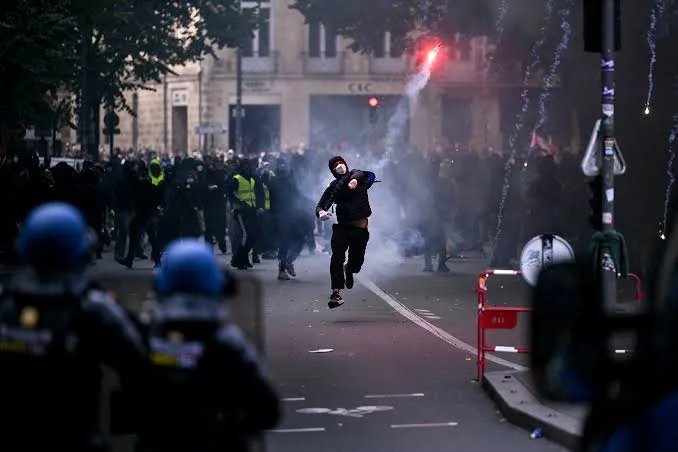
France is facing renewed political and social tension as weeks of protests over rising living costs, deteriorating public services and alleged police brutality have been accompanied by looting, vandalism and clashes with security forces.
The unrest has intensified scrutiny of radical-left groups, with President Emmanuel Macron accusing “delinquents” and “ultra-left groups” of seeking to undermine the French Republic.
Also read: Over 450 German schools receive bomb threats
However, an investigation by BBC correspondent Katya Adler, based on interviews with protesters, activists and a former police commissioner, suggests that the movement behind much of the violence is more fragmented than the President’s remarks might imply.
The protests have become a major political issue ahead of France’s next presidential and parliamentary elections, with political factions offering competing explanations for the unrest.
The left has blamed economic hardship and government policies for the public anger, while critics have accused radical-left elements of encouraging violence.
Nationalist groups, meanwhile, have promised to restore order and security if they gain political power.

At the centre of the controversy is the Black Bloc, a loose protest tactic associated with demonstrators who wear black clothing, masks and other face coverings to conceal their identities during confrontations with police.
The movement has appeared at demonstrations across Europe, often becoming more visible towards the end of daytime protests, when masked protesters emerge from side streets as riot police move in.
In France, the authorities have struggled to contain the scale of the unrest. Intelligence agencies reportedly underestimated the anger and destruction that followed demonstrations the previous month.
More than 1,000 police officers were reportedly injured, while some young protesters sustained serious injuries, including broken bones. Two people were also reported to have lost hands during confrontations involving police stun grenades.
The newspaper Le Monde has continued to document reports of injuries among protesters, while the French Insurers Federation estimated that damage to shops and private property during the biggest riots on October 17 amounted to approximately €207m.
Since then, police deployments at demonstrations have increased, with protesters accusing officers of using excessive force.
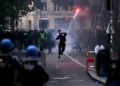
During one demonstration witnessed by the BBC, masked protesters carrying glass bottles and homemade paint bombs were heavily outnumbered by riot police equipped with batons, tear gas and stun grenades.
Adler spoke with several young protesters who agreed to interviews only on condition that their identities remained concealed.
One of them, an 18-year-old identified as Nas, said he and his friends were angry about poor living conditions, inadequate schools and limited opportunities in disadvantaged suburban communities known as banlieues.
Asked how he justified violence, one of the young men argued that it was necessary to make their voices heard.
He said their schools were struggling, teachers were leaving and young people faced difficulties obtaining the qualifications needed for decent employment.
The group insisted they had not been recruited or organised by radical-left movements, describing their actions as a response to frustration and a lack of confidence in the system.
Two masked student activists interviewed by the BBC also defended the grievances behind the protests, although they acknowledged that violence could damage the reputation of their movements.
One argued that the destruction of property was less serious than the use of stun guns against protesting schoolchildren, while pointing to the difficulties many people faced in affording basic necessities.
They also accused the state of using violence against demonstrators, arguing that police actions were a more significant concern than damage caused during protests.
The investigation also identified more organised elements within the Black Bloc.
A 17-year-old activist who used the codename Anticapitalist Starflix described himself as a member of the movement and admitted using homemade paint bombs against riot police.
He showed the BBC devices made from eggshells filled with paint and sealed with medical tape. He said protesters threw them at police helmet visors to obstruct officers’ vision.
He also admitted that demonstrators collected stones and other objects from the streets to throw at police.
Starflix explained that the Black Bloc was not a single organisation but a method of protest used by people with different motivations.
“The Black Block isn’t a single organisation. It’s a technique,” he said.
He added that some participants used violence to demand government reforms, while others exploited the anonymity provided by masks and similar clothing to steal during demonstrations.
According to the teenager, he wanted a revolution, while acknowledging that he was afraid of being injured or arrested.
He said he was more concerned about the possibility that society would remain unchanged.
Social media and encrypted messaging platforms also feature prominently in the organisation of protest activity.
Starflix said he and his associates used Signal and Telegram to coordinate their attendance at demonstrations.
The BBC also identified websites and Instagram accounts associated with left-wing groups that shared advice for protesters, including covering their faces, avoiding phone tracking and moving through crowds to evade police.
Some of the guidance echoed tactics used by demonstrators during the 2019 Hong Kong protests.
However, the investigation did not establish that these online platforms or groups were directing the violence.
A more experienced Black Bloc activist also rejected Macron’s suggestion that the radical left operated as a coordinated network seeking to overthrow the French Republic.
He argued that people often joined demonstrations independently, with anger rather than formal organisation providing the common motivation.
The activist also denied that Jean-Luc Mélenchon and his France Unbowed party were responsible for the violence, claiming that the party and trade unions were more interested in calming unrest than escalating it.
He said his objective was not to destroy France but to replace what he regarded as an unjust capitalist system.
Beyond the cities, the BBC investigation found more established radical-left networks involved in environmental activism and direct action.
In Limoges, a fire at the town hall during protests had left extensive damage to the historic building. A 34-year-old man was in police custody in connection with the incident but maintained his innocence.
The BBC also spoke to a 39-year-old activist who had been involved in the local radical-left movement for more than two decades.
He defended taking action against what he described as social injustice and criticised the use of force against young protesters.
His comments included a warning that the public’s anger could become more dangerous if authorities continued to ignore its grievances.
Despite such rhetoric, the investigation found little evidence that radical-left groups possessed the organisation, manpower or weapons needed to pose a serious threat to the French state.
Michel Klein, a recently retired police commissioner, said he believed radical-left and anarchist groups wanted to undermine the Republic but lacked the means to achieve that objective.
He also dismissed the prospect of civil war, although he warned that clashes between far-left and far-right groups could become more frequent as the elections approached.
Far-right vigilante groups have already begun appearing around demonstrations in several French cities, claiming they want to protect the streets.

Also read: Over 450 German schools receive bomb threats
With political tensions rising, the challenge for France remains how to address legitimate public grievances while preventing violent groups from exploiting the unrest.

Mariam Balogun is a contributor to Freelanews.com, covering news, business, and public affairs.