

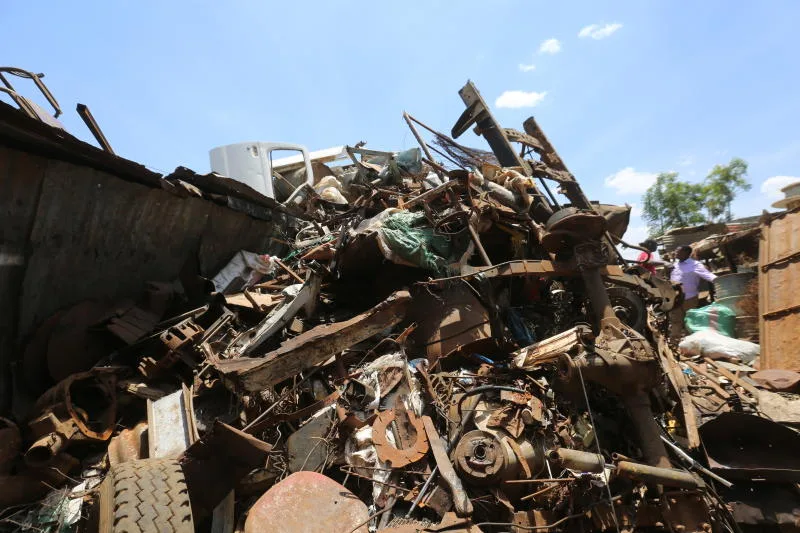

The Federal Government has assured legitimate scrap metal collectors, traders and recyclers that proposed regulations for the industry will not threaten their businesses or livelihoods.
The Minister of Steel Development, Shuaibu Audu, gave the assurance on Tuesday during a stakeholders’ engagement in Kano, explaining that the initiative was designed to tackle the theft and vandalism of public infrastructure while creating a more organised scrap metal market.
Also read: Senate approves Tinubu’s $20.5bn external borrowing plan
Audu, represented by the Director of the Steel and Non-ferrous Metals Department, Umar Tsoho, said the government intended to formalise the industry without restricting lawful commercial activities.
In a statement issued by the ministry’s Head of Press and Public Relations, M.A. Tine-Iulun, the minister said the framework would enable legitimate operators to conduct business while preventing criminals from using the scrap metal trade to dispose of stolen materials.
The proposed regulations come amid growing concerns over the removal of metallic components from electricity installations, railway facilities, pipelines, manhole covers and other public infrastructure.
According to the minister, such thefts cause more than financial losses, as they disrupt essential services, endanger lives, increase maintenance expenses and obstruct national development.

He said the government planned to introduce licensing and monitoring requirements, improve transaction records and establish operational standards for collection centres, aggregation facilities and recycling plants.
Audu, however, described scrap metal as an important raw material for Nigeria’s industrial sector, particularly steel production, foundries and manufacturing.
He noted that a well-managed recycling system could generate employment, support industrial growth and strengthen the country’s transition towards a circular economy.
The minister maintained that Nigeria’s ambition to build a competitive steel industry required a dependable supply of legally sourced scrap metal, handled safely and distributed through transparent channels.
He also said the proposed framework would recognise the circumstances of small-scale operators by introducing formalisation requirements suited to the size and risks of their businesses.
While small collectors would not be subjected to excessive regulatory demands, he explained that large-scale aggregation, processing and recycling facilities would be expected to comply with appropriate operational and environmental standards.
The Kano consultation followed an earlier engagement with stakeholders in Lagos from November 9 to 10, where discussions covered licensing, operator classification, traceability, environmental protection, workplace safety, security and enforcement.
Audu said the second meeting was intended to capture additional regional perspectives, particularly the experiences of operators in northern Nigeria.
He urged participants to submit practical recommendations, assuring them that contributions from both engagements would be reviewed and harmonised within the relevant legal framework.

The ministry, he added, was prepared to collaborate with government agencies, industry operators, environmental authorities and security organisations to ensure effective implementation.
Also speaking, the Permanent Secretary of the ministry, Amb. Nura Abba Rimi, represented by the Director of Metallurgical Inspectorate and Environmental Protection, Christopher Wanje, said the consultations were necessary to ensure the proposed rules reflected the realities of businesses across the country.
He said the regulations would address weaknesses in the industry through licensing, compliance measures, better tracking of transactions, environmental safeguards and stronger monitoring.
Rimi encouraged stakeholders to make further recommendations on licensing, operator classification, security arrangements, environmental protection and cooperation among government agencies.
The Acting Executive Secretary of the National Steel Council, Aminu Shehu, represented by the Head of Planning, Research and Statistics, Nana Firdausi Muhammad, also expressed support for the initiative.
She said proper regulation could improve transparency, expand employment opportunities and contribute to economic growth.
Similarly, the Kano State Commandant of the Nigeria Security and Civil Defence Corps, Mohammed Hassan Agalama, speaking on behalf of the Commandant-General, Prof. Ahmed Abubakar Audi, backed the proposed framework.
Agalama said stronger oversight of the scrap metal trade was necessary to protect critical national assets, including electricity infrastructure, pipelines, railway facilities and government property.
Also read: Senate approves Tinubu’s $20.5bn external borrowing plan
He pledged the corps’ readiness to work with the Ministry of Steel Development and other relevant agencies to enforce the proposed regulations.

Peculiar Adirika is a journalist and contributor to Freelanews.com, covering news, business, and public affairs.