
Canada’s decision to exclude Russian athletes from the 2027 World Junior Ice Hockey Championship has dealt a fresh setback to Russia’s efforts to return to international sport, despite a landmark ruling by the Court of Arbitration for Sport (CAS) ordering the International Ice Hockey Federation (IIHF) to readmit Russian teams.
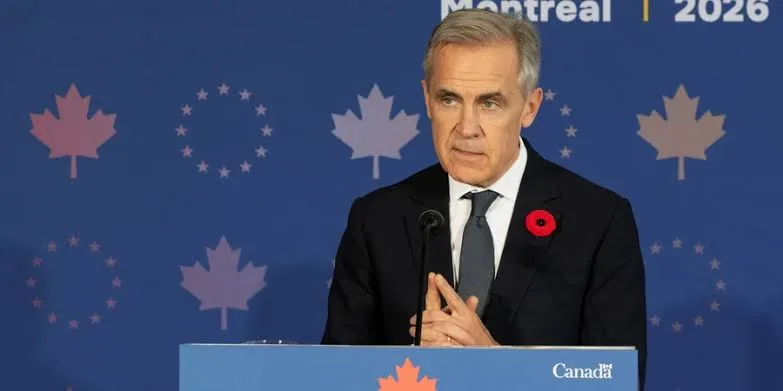
On Sunday, 15 November 2026, the Canadian federal government, led by Prime Minister Mark Carney, maintained its restrictions on Russian and Belarusian sporting representatives, prompting the IIHF to confirm that Russia’s Under-20 national team would not compete in the championship scheduled for Edmonton and Red Deer, Alberta, from 26 December 2026 to 5 January 2027.
Also read: Aisha Yesufu warns NDC will resist political attacks
The decision followed weeks of uncertainty over Russia’s eligibility after CAS ruled on 30 October that the IIHF must allow Russian teams to participate in five designated international competitions during the 2026-27 season.
The IIHF confirmed that the Canadian government’s position had made Russia’s participation impossible, adding that the federation had considered alternative hosting arrangements before deciding to keep the tournament in Canada.
“The IIHF confirms that due to the position and restrictions formally communicated by the Canadian Government, the Russian U20 national team is unable to participate in the World Junior Championship,” the federation said in its statement.
The IIHF added that the tournament would proceed as originally scheduled, with an updated competition programme to follow.

The Canadian position had been made clear earlier in the week by Adam van Koeverden, Secretary of State for Sport, who said Russian and Belarusian athletes and officials would face individual assessments designed to prevent their entry into Canada for sporting competitions, even where valid visas had already been issued.
Van Koeverden explained that Canada’s restrictions were linked to Russia’s continuing war against Ukraine and the involvement of Belarus in the conflict.
The Canadian government has also drawn a distinction between individual athletes competing under neutral arrangements and national teams representing their countries.
That distinction proved decisive for the Russian Under-20 side, whose participation would have required entry as a national team rather than as a collection of independent neutral competitors.
Speaking after the IIHF announcement, Van Koeverden reinforced Ottawa’s position, saying: “Canada’s position is unequivocal: until Russia ends its war of aggression against Ukraine, Russian and Belarusian representation should not be permitted in international sport.”
The latest development has also exposed the limits of the recent CAS ruling, which ordered the IIHF to restore Russian participation but did not itself guarantee that Russian players would receive permission to enter Canada.
The October ruling followed an appeal by the Russian Ice Hockey Federation against the IIHF Council’s June 2026 decision to maintain the country’s exclusion on safety, security and operational grounds.
In its 30 October statement, CAS confirmed that the appeal had been upheld and specifically ordered the IIHF to allow Russian teams into five competitions: the 2027 World Junior Championship in Canada, the Under-18 Women’s World Championship in the Czech Republic, the Under-18 Men’s World Championship in the United States, the 2027 Men’s World Championship in Germany and the 2027 Women’s World Championship in Canada.
The ruling marked a significant legal victory for Russian hockey, particularly after the IIHF had maintained that security concerns justified the restrictions introduced following Russia’s full-scale invasion of Ukraine in February 2022.
However, the ruling did not bring an immediate end to the wider dispute surrounding Russia’s return.
The IIHF had already expressed disagreement with the CAS decision, arguing that implementing the ruling would require extensive discussions with national associations, tournament organisers and host authorities.
The federation also highlighted the practical difficulties associated with changing competition formats, travel arrangements, accommodation and security planning at relatively short notice.
The Russian Ice Hockey Federation reacted angrily to the latest exclusion, describing the outcome as unacceptable and unlawful and indicating that it would appeal to the International Olympic Committee (IOC).

“The IIHF’s decision was made solely due to political reasons,” the Russian federation said.
The organisation argued that excluding the national team breached principles of non-discrimination, equality among athletes and the integrity of international sporting competitions.
Russia’s renewed absence will also have consequences for Norway, whose Under-20 team had faced the prospect of losing its place after the IIHF initially indicated that Russia would be accommodated in the tournament following the CAS ruling.
The Norwegian Ice Hockey Association subsequently confirmed that Norway had regained its place after Russia’s exclusion was finalised.
Association secretary general Petter Salsten welcomed the development, saying the decision was positive for the players, coaching staff and the wider Norwegian hockey community.
Salsten said the team had been preparing for the championship for a year but had spent the previous month uncertain about its participation.
Norway’s pre-tournament training camp and scheduled matches in Canada are expected to proceed as planned, restoring some certainty for a team that had earned promotion through its sporting performance.
The development also carries implications beyond the junior competition.
Russia’s potential return to the 2027 Men’s World Championship in Germany has already generated resistance from several European hockey federations.
Austria, the Czech Republic, Denmark, Finland, Latvia, Norway and Sweden have indicated that their national teams would refuse to play against Russia if the country were readmitted.
The controversy has also raised commercial concerns, with one sponsor withdrawing and other partners reportedly considering their positions.
Germany, which is due to host the men’s championship from 14 to 30 May 2027, has called on the IIHF to clarify the situation as soon as possible.
German Ice Hockey Federation chairman Frank Lutz said organisers needed certainty for participating teams, supporters and commercial partners ahead of the competition.
The uncertainty surrounding Russian participation has therefore become a significant organisational challenge for the IIHF, which must balance the legal implications of the CAS ruling against the concerns of national federations and host countries.
The wider debate has intensified as international sporting organisations reconsider restrictions introduced after Russia’s invasion of Ukraine in February 2022.
In July 2026, the IOC provisionally lifted the suspension of the Russian Olympic Committee, which had been imposed in October 2023 over the inclusion of regional sports organisations from Ukrainian territories under Russian occupation.
The IOC said the decision followed assurances that the Russian Olympic Committee no longer included those organisations among its members.
The IOC also stated that its previously recommended participation conditions for Russian athletes and teams were no longer applicable.
However, the decision did not automatically compel every international sports federation or host government to admit Russian competitors.
Individual governing bodies continue to operate under their respective regulations, while national authorities retain responsibility for immigration and border controls.
The distinction has produced differing approaches across international sport, with some federations easing restrictions while others maintain exclusions or require neutral participation arrangements.
For the IIHF, the Canadian dispute presents a particularly complicated situation because the governing body must implement a binding arbitration decision while dealing with the practical limitations imposed by its host country.
For the young Russian players, the immediate consequence is the loss of an opportunity to compete on one of junior ice hockey’s most prominent international stages.
For Norway, the reversal provides a welcome return to a competition place earned through sporting achievement.
For Canada and the IIHF, the tournament will proceed without one of the sport’s traditional powers, leaving the broader question of Russia’s international eligibility unresolved as preparations continue for the 2027 championship.
Also read: Aisha Yesufu warns NDC will resist political attacks
The dispute is another reminder that the return of Russian athletes to international competition remains dependent not only on sporting and legal decisions but also on the political positions of host nations and the willingness of other participating countries to compete.

Mariam Balogun is a contributor to Freelanews.com, covering news, business, and public affairs.