

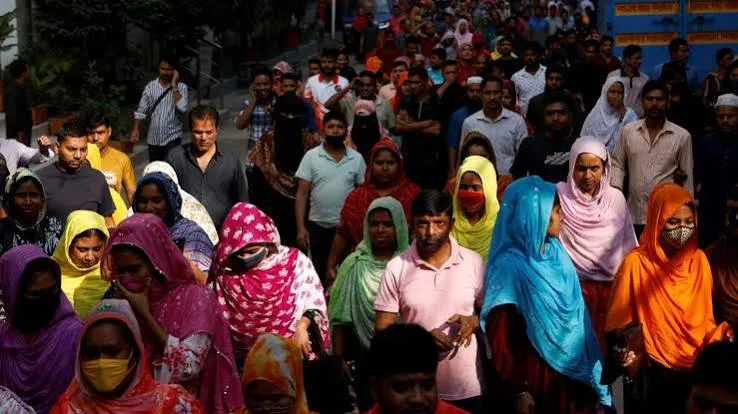

Bangladesh’s garment workers have been offered a 36 per cent increase in the monthly minimum wage following months of protests that disrupted factory operations and reportedly cost the country’s economy hundreds of millions of dollars.
The chairman of the government-appointed garment industry wage board announced on Wednesday that a majority of its members had agreed to raise the minimum monthly wage from 12,500 taka, approximately $100, to 17,500 taka, around $136.
Also read: Gambia election: voters demand jobs, justice and change
The proposed increase, however, falls short of the 30,000 taka, or approximately $240, demanded by protesting workers. It remains unclear whether the new offer will be accepted by the workforce.
Babul Akhter, the labour representative on the wage board established to address the dispute, described the outcome as a partial improvement, although he acknowledged that workers might not be entirely satisfied.
“Although we are not completely satisfied, the outcome is not entirely bad either,” Akhter told reporters, urging workers to return to their factories.
He said the latest adjustment was significant because workers had previously waited five years between wage revisions, whereas the new increase came after three years.

The revised wage is scheduled to take effect in December, with workers expected to receive the higher salaries from January.
The dispute has placed renewed attention on the economic conditions of millions of people employed in Bangladesh’s garment industry, a major pillar of the country’s economy.
Bangladesh’s central bank describes the sector as the country’s “export engine”.
The industry generates approximately $38bn annually, employs about four million people and accounts for roughly four-fifths of national exports.
Many of its workers are women from rural communities.
The scale of the disruption has also raised concerns among manufacturers about the country’s competitiveness in the global clothing market.
The Bangladesh Garment Manufacturers and Exporters Association said on Sunday that the protests had caused estimated industry losses of $428m, while orders valued at $254m had reportedly shifted to other countries.
Bangladesh is the world’s second-largest garment exporter after China.
The industry has played a central role in the South Asian country’s economic development, creating millions of jobs and generating substantial export revenue.
However, its success has long been accompanied by concerns about workers’ welfare, factory safety and working conditions.
In 2013, the collapse of the Rana Plaza factory complex killed 1,134 people and injured thousands, exposing serious safety failures across the industry and prompting international scrutiny of garment production in Bangladesh.

Other industrial disasters, including factory fires, have also claimed numerous lives over the years, reinforcing calls for stronger workplace protections.
Also read: Gambia election: voters demand jobs, justice and change
The latest wage agreement represents an attempt to ease tensions between workers and employers, but the gap between the proposed minimum wage and workers’ original demand leaves uncertainty over whether it will bring lasting relief to the sector.

Mariam Balogun is a contributor to Freelanews.com, covering news, business, and public affairs.