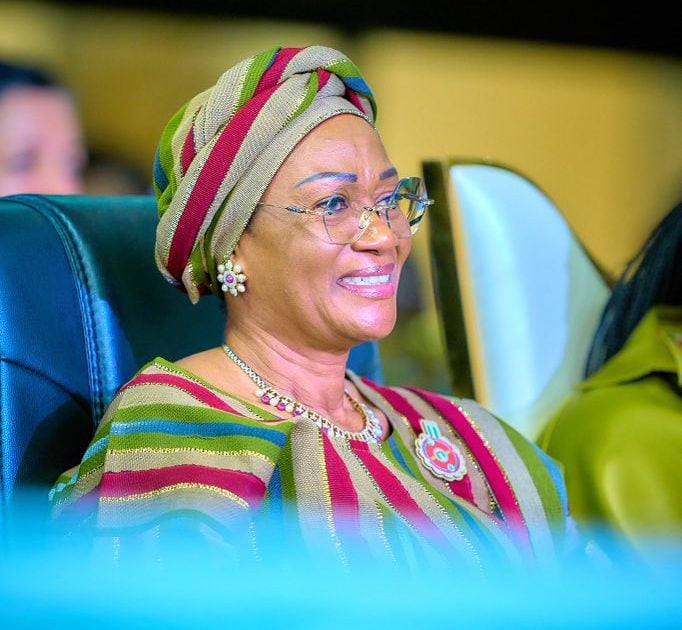

This profile explores her Yoruba and Itsekiri roots, upbringing, heritage and identity as Nigeria’s First Lady.
In Nigerian politics, identity is never a quiet matter. It travels loudly through surnames, accents, hometowns and, increasingly, social media arguments.
Against this backdrop stands Oluremi Tinubu, Nigeria’s First Lady since May 2023, a woman whose public life has been marked more by restraint than rhetoric. Yet a recurring question continues to trail her presence in public discourse: is Oluremi Tinubu truly a Yoruba woman?
The short answer is yes. The fuller answer is more layered, and far more interesting.
Born on September 21, 1960, Oluremi was raised in the old Western Region, growing up in Ogun State, where Yoruba culture is not merely practiced but lived.
She was the twelfth of thirteen children, raised in a large, disciplined household where communal values shaped daily life.
Ijebu Ode, her childhood home, is one of the cultural heartlands of Yorubaland, a town steeped in history, ritual and an enduring sense of identity. The manners, speech patterns and cultural ease she carries today are unmistakably rooted in that environment.
Her father, Chief Josiah Afolabi Ogunleye, came from the Ikusebiala family of Ijebu Ode.
His lineage sits firmly within the Ijebu subgroup of the Yoruba people, known for their commercial acumen, deep respect for tradition and strong kinship structures.
From him came Oluremi’s grounding in Yoruba values: respect for elders, discipline, faith in education and a strong sense of community responsibility. These influences shaped her formative years and remain evident in her public engagements and personal conduct.
But Oluremi Tinubu’s story does not rest on a single lineage.
Her mother was Itsekiri, from Delta State, bringing into the family the rhythms and stories of the Niger Delta.
The Itsekiri people, though fewer in number, possess a proud history rooted in maritime trade, monarchy and cultural resilience.
Linguistically close to Yoruba yet culturally distinct, the Itsekiri occupy a unique space in Nigeria’s ethnic tapestry.
Oluremi’s ease with the Itsekiri language, which she has spoken publicly on several occasions, reflects not performance but familiarity. It is the voice of someone who grew up hearing lullabies, folktales and everyday conversations shaped by that heritage.
In her childhood home, Yoruba customs did not cancel out Itsekiri traditions. Instead, they coexisted.
This dual exposure meant that identity was never framed as a competition but as a shared inheritance. Yoruba festivals and Itsekiri narratives occupied the same domestic space, producing a woman comfortable in more than one cultural skin.
Still, Nigeria’s political climate rarely rewards nuance.
During the intense divisions that surrounded recent elections, Oluremi Tinubu’s background became fodder for speculation. Some questioned her Yoruba authenticity. Others celebrated her mixed heritage as proof of national unity. Through it all, she remained largely silent, allowing her work to speak.
That work is substantial. As a three term senator representing Lagos Central and later Lagos East, she built a legislative record focused on women, children and social welfare.
Through the New Era Educational and Charity Trust, she has supported vulnerable children for decades.
As First Lady, she has continued to prioritise education, health and the fight against gender based violence, aligning her efforts with the Renewed Hope Agenda.
Her marriage to Bola Ahmed Tinubu, which began in 1980, has also unfolded largely away from spectacle.
Together they raised three children and navigated the pressures of public life long before national power arrived. Throughout those years, Oluremi Tinubu cultivated a reputation as a steady presence rather than a political loudspeaker.
So, is Oluremi Tinubu a Yoruba woman?
By heritage, upbringing and cultural grounding, she clearly is.
But she is also Itsekiri by blood, and proudly so.
More importantly, she represents a reality that predates modern political divisions: that Nigerian identities have long been intertwined, shaped by migration, marriage and shared history.
Perhaps the better question is not whether she fits neatly into one ethnic box, but why such boxes still matter so much.
Oluremi Tinubu’s life quietly suggests an answer. Identity, she demonstrates, can be rooted without being narrow, and inclusive without being confused.
In her story, one sees a reflection of Nigeria itself: complex, blended, sometimes contested, yet richer for its diversity.

Ojelabi, the publisher of Freelanews, is an award winning and professionally trained mass communicator, who writes ruthlessly about pop culture, religion, politics and entertainment.